
Work Order Details-HQ
The Work Order Details section provides a complete overview of active job parameters, service requirements, and billing configurations.
- Open vs. Completed Work Orders: This article focuses on navigating an open work order. Once a work order is completed, additional audit and closing detail fields will become available in this view.
- Editing Details: Click the Edit button in the top right corner at any time to update general work order parameters across any of the active tabs.
How do I change the dispatch board view (e.g. card vs. table view)?
How do I view the work order details?
What does the Overview section include?
What does the Activity section incude?
What does the Segments section include?
What does the Inspection section include?
What does the Labor section include?
What does the Travel section include?
What does the Parts section include?
What does the Misc. Charges section include?
What does the Codes section include?
What does the Attachments section include?
What does the Comments section include?
What does the Requests section include?
What does the Communications section include?
What does the Billing section include?
What does the Audits section include?
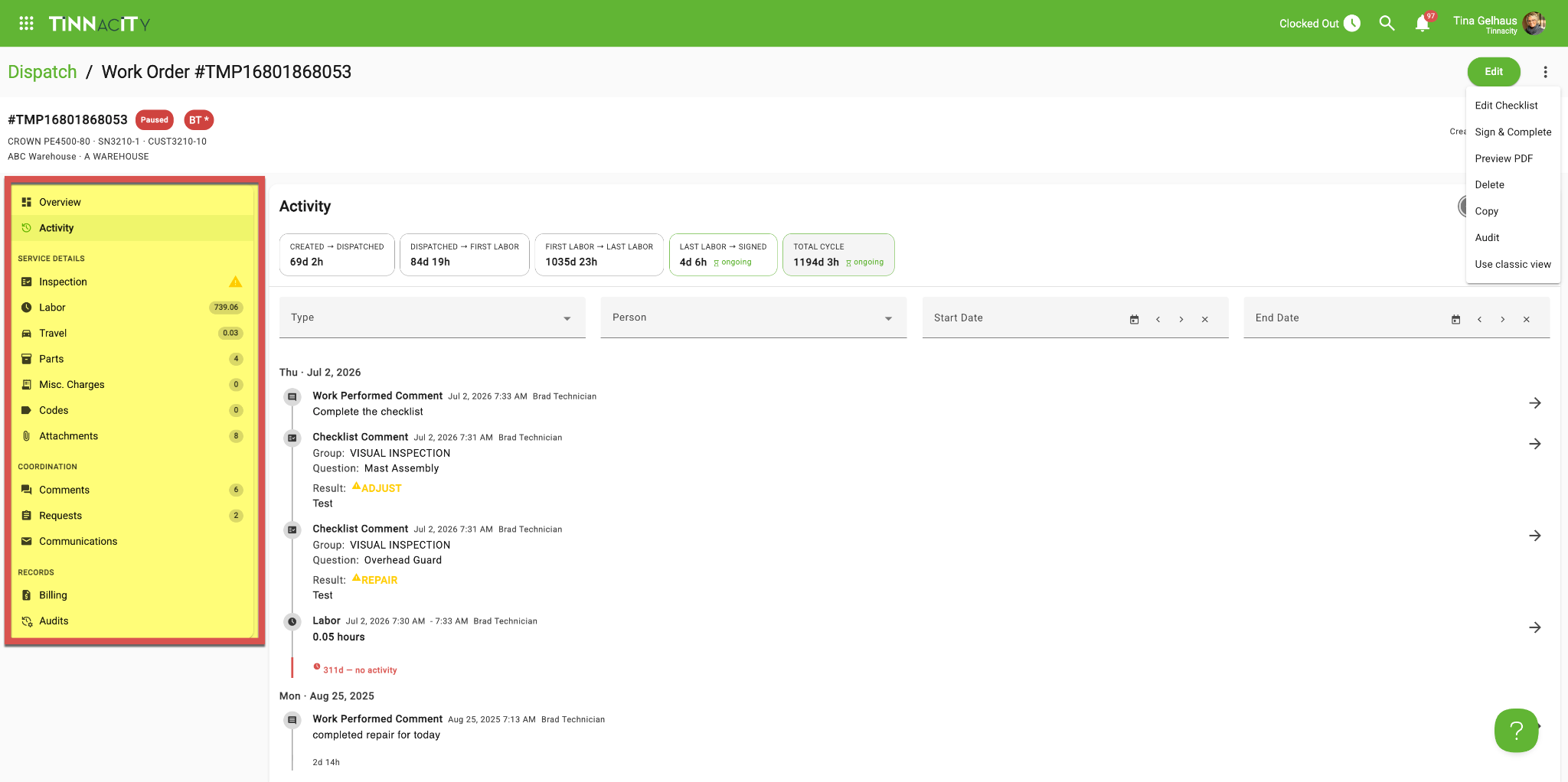
What does the Three Dots Menu include?
Dispatch Board Views
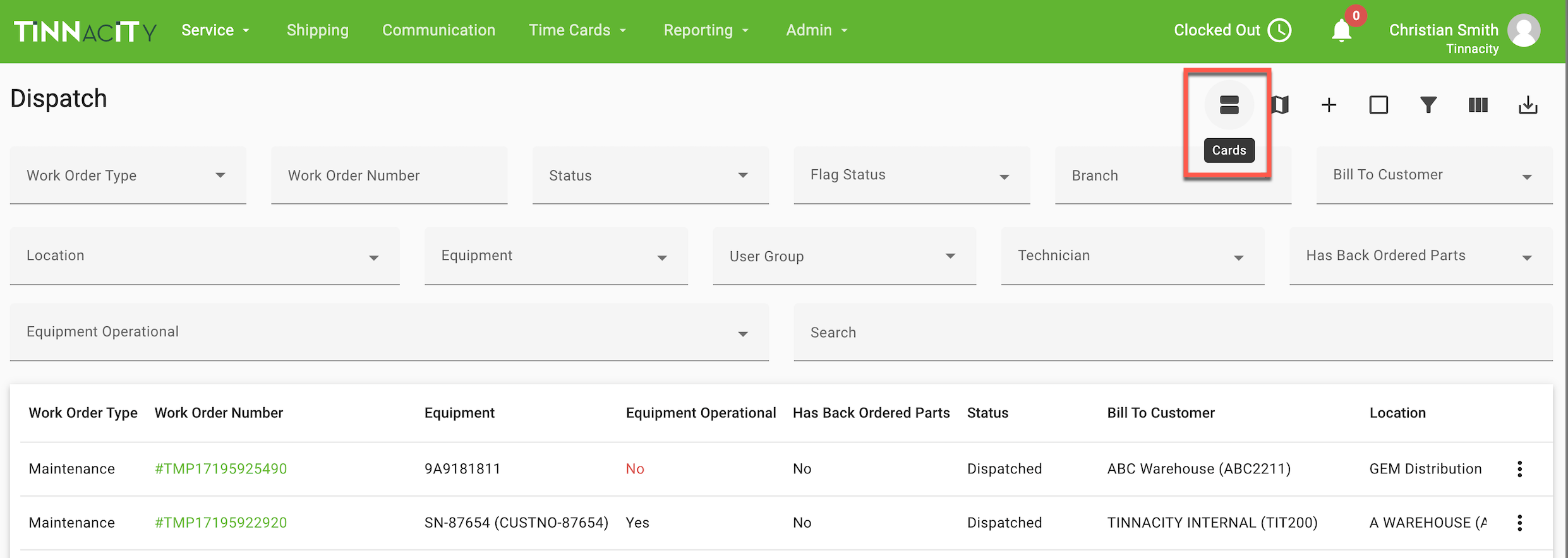
Within HQ>Service>Dispatch, there are 2 ways to view the Dispatch screen which can be selected by clicking on the Table icon in the top right or the Cards icon, depending which view you prefer.
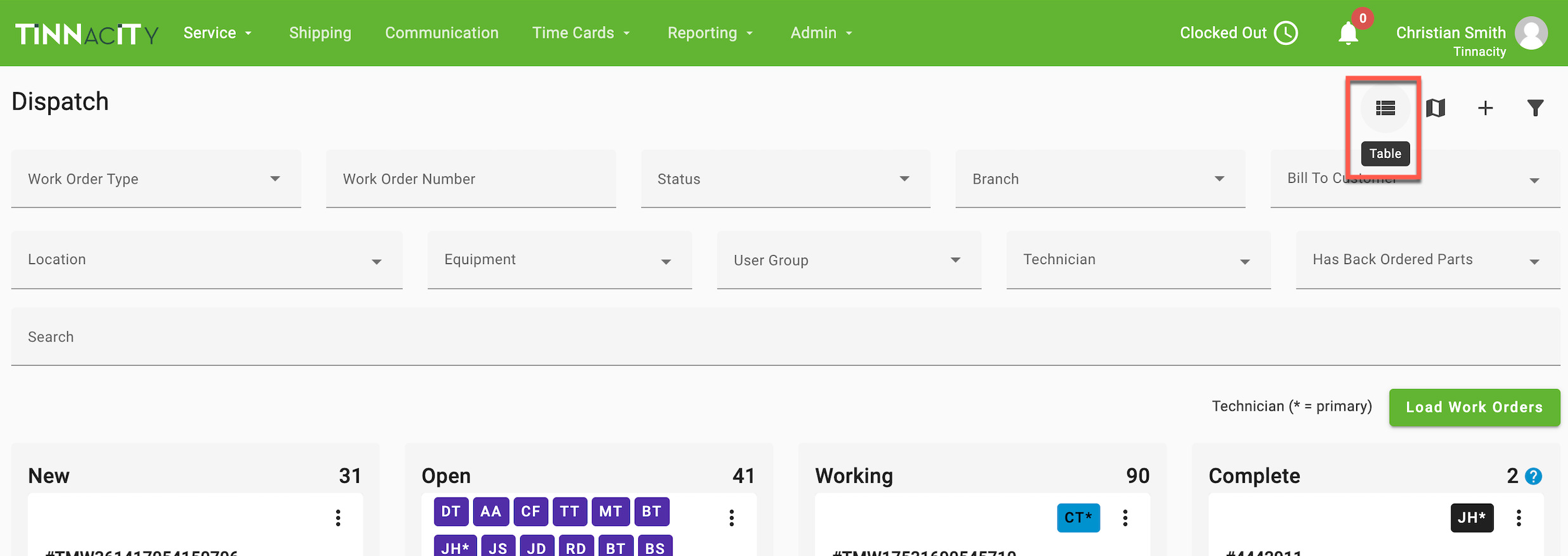
Dispatch Board (Card View)
- Details can be viewed by selecting the 3 dot-menu and choosing "Details"
- -OR- Simply click the card on the dispatch board to view the details

Dispatch Board (Table View)
- Details can be viewed by selecting the 3 dot-menu and choosing "Details"
- -OR- Simply click on the work order number

How to find it
- Navigate to Service > Dispatch or History.
- Click a work order number to open its details.
-
Use the new left panel to jump between views — no more scrolling through bottom tabs.
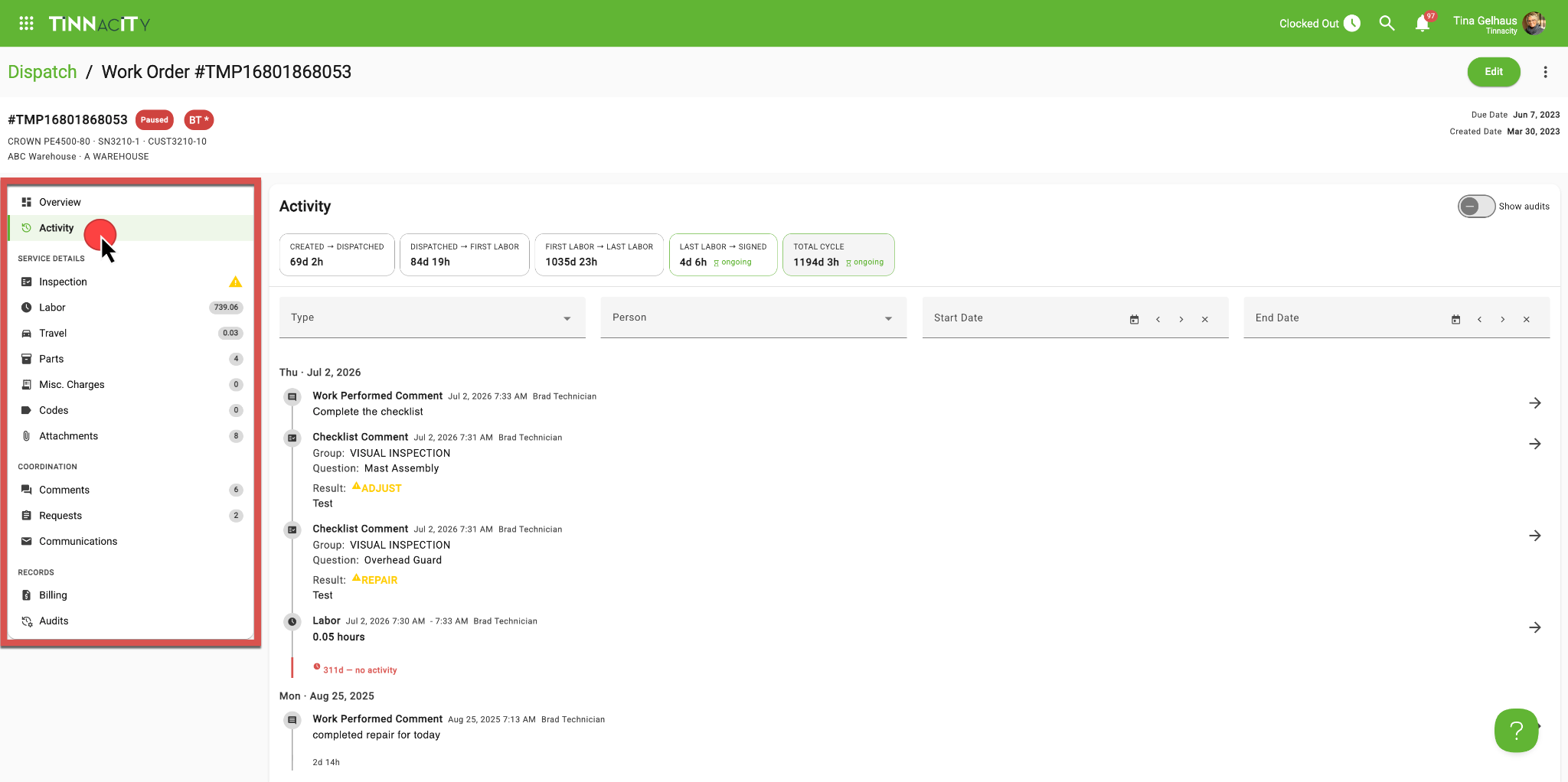
Work Order Details Screen
To edit general work order details at any point while navigating these sections, click the Edit button in the top right corner of the screen.
The panel on the left include clickable view names.
- Overview — the specifics of the work order
- Activity — a timeline of key events
- Inspection — if applicable
- Labor — all billable labor hours
- Travel— all billable travel hours
- Parts— all billable parts used
- Misc. Charges — if enabled
- Codes
- Attachments
- Comments— work performed notes and private comments
- Requests — any technician or back-office requests submitted for the work order
- Communication — SMS, if applicable
- Billing— quoted hours, PO Number, Payment Terms, Payment Link and Invoice Number
- Audits— changes made to the work order with action type, old value, new value, changed by, and date it was changed
Overview
The Overview section includes various details for the Location, Equipment, Work Order Description, and Statuses.

- Location - Displays the Bill To (customer) & Ship To (location) information on the work order. Contact information will also show if provided.
- Equipment - Displays the associated Serial No, Customer Unit No, Internal Unit No, Make, Model and Meter (if applicable). If there are dates/times entered for Equipment In/Out, this will also show. Click here to learn more about Equipment In/Out.
- Status - Displays information surrounding the current status and general information gathered with the work order. These include:
- Original WO number, if applicable (typically a TM + number if created by a technician or TMW + number via HQ)
- Created Date
- Work Order Type
- Where Serviced (Shop/Field/Other)
- Status (New, Open, Traveling, Working, Paused, Technician or Customer Review, Paperwork Complete)
- Related Work Orders - will display the number of segments for the work order (must be supported by business system)
- Synchronization - This should only be changed to enable synchronization of administrative travel and/or labor hours
- Due Date (can modify or add)
- Schedule Date. Click here to learn more on Scheduling
- Priority
- Estimated Completion Date (can be set by HQ or technicians)
- Arrival Date/Time - when the technician first starts working on the work order (i.e. the work order changes to status of In Progress)
- Start of First Labor
- End of Last Labor
- Once a work order is complete, the following will display in the Status Card:
- Sign Name, Email & Date
- Sent Paperwork - who received a copy of the completed work order. NOTE: Once a work order is complete, HQ users can still send the completed PDF with the work order details if needed by selecting the 3 dots in the top right of the work order details screen and selecting Email
- Paperwork Date
- Collect Date - if integrated to back office business system, the date in which the completed information was collected.
- Travel Back Used - The time applied to Back End Travel (after the work was completed & if enabled in HQ>Company Settings>Service Settings)
- First-Time Fix (Yes/No) (can be updated by HQ)
- Customer Damage (can be updated by HQ)
- Flag Status - Work orders can be flagged with different colored flags that will display here and in the History page. These flags do not have any built-in functionality and are for viewing purposes only.
- Technician(s) - All technicians assigned to the work order. Click a technician's tag to see their status. If a Secondary Technician's status is Signed, the work order is still open, and the other technicians on it have not completed their portions, click Move to Paused to let them continue working on it.
- Billing- Quoted Hours,PO Number, Payment Terms, Payment Link and the Invoice Number. Click here to learn more about Payment Terms.
- Description-Displays the problem reported or reason for the work order
- Labels- Labels can be applied by technicians and by HQ users. These Labels can be created and managed in HQ>Admin>Labels only. Labels are used to help identify different characteristics about a work order. Click here to learn more.
Activity
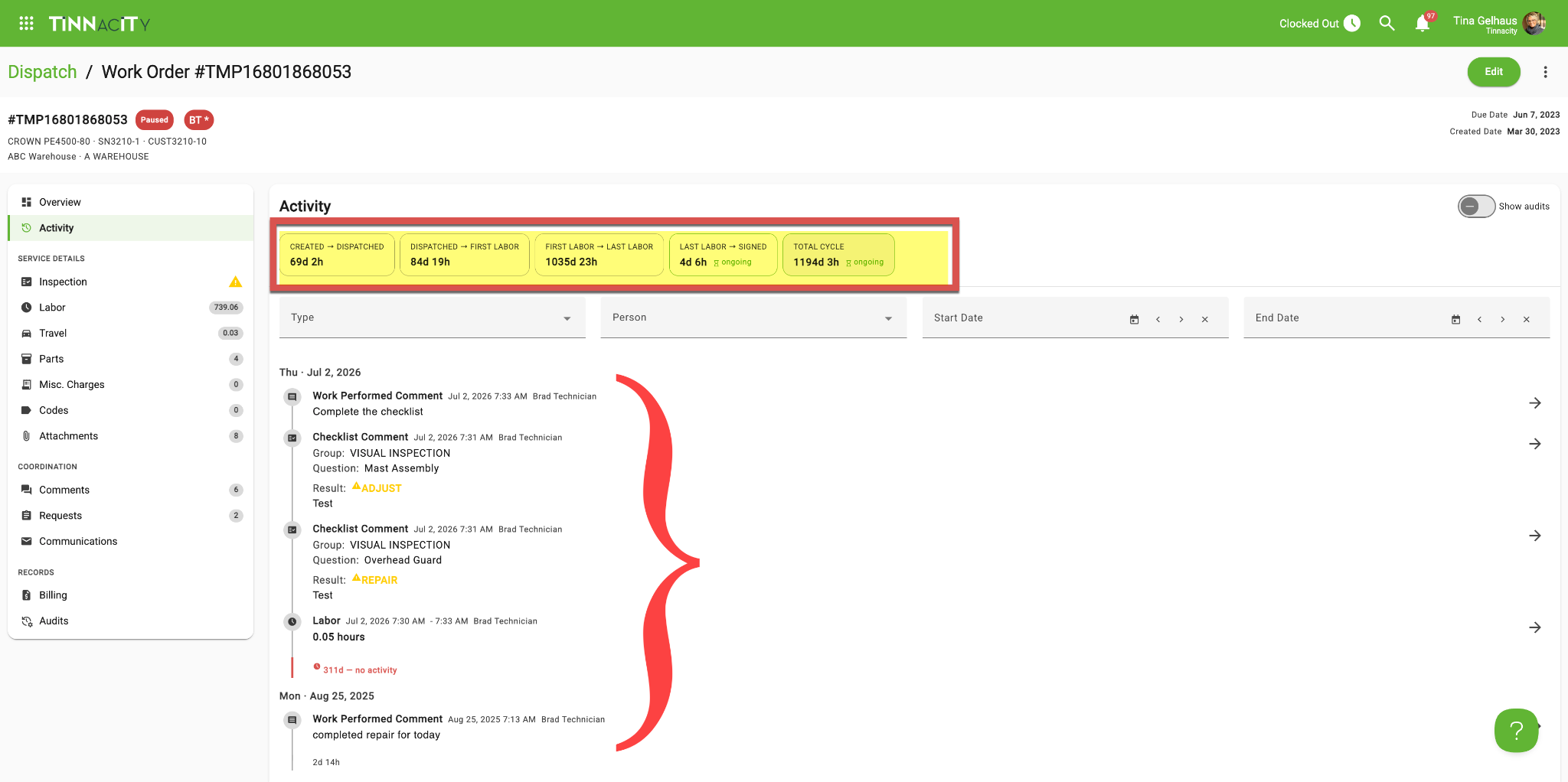
The Activity view shows a full timeline for the work order: when it was created, when travel was applied, when labor was applied, when work-performed notes were added, and when the work order was completed. As well as the number of days and hours for:
- Created to Dispatch
- Dispatched to First Labor
- First Labor to Last Labor
- Last Labor to Signed
- Total Cycle Count
Segments (If enabled)
The Segments view allows you to view and manage all segments on the work order by clicking [Manage all Segments].

What are segments?
Multiple segments on a repair work order allow you to break a single job into distinct sections based on specific tasks, equipment areas, or components needing attention.
Segmenting your work orders helps you:
- Streamline Tracking & Management: Easily track progress, assign responsibilities, and manage resources across different parts of a complex repair.
- Consolidate Billing: Group all completed work onto a single, clean invoice for the customer.
- Batch Equipment Maintenance: Combine multiple assets into one parent job. For example, rather than creating 90 separate work orders for a customer like ABC Warehouse, you can manage preventive maintenance (PM) for all 90 pieces of equipment inside a single Planned Maintenance work order.
Contact help@tinnacity.com to learn more about segments and if segments are supported for your business system.
Inspection
The Inspection section allows you to view and manage assigned checklists for a work order.
Managing Checklists & Questions
- Change Checklist: Click Edit Checklist to change the assigned checklist for the active work order. (Note: Checklists cannot be modified if viewing the work order from History).
- Show Issues: Click Show Issues to filter and quickly highlight flagged items.
- Expand/Collapse: Click Expand All to view full details and attached images for all questions, or Collapse All to simplify the view.
Important Notes on Image & Attachment Visibility:
- Standard Work Orders: Attached inspection images are not visible to customers automatically. If a customer needs these photos, you must download and email them manually.
- Customer Portal: Clients utilizing the Customer Portal have full visibility to attached inspection files. Contact sales@tinnacity.com for more information on configuring customer access.

Labor
The Labor section displays hours billed to the customer based on rate settings, minimums, maximums, and rounding rules configured for the Work Order Type.
Rate Settings
- The Rate Settings card displays the work order type's minimum labor time, maximum labor time, and rounding rule.
Managing Labor Entries
- Add Billed Hours: Click [Add Labor] to manually add a new labor entry.
- View Daily Details: Click the arrow next to a specific date to expand and view the itemized entries for that day.
- Modify Entries: Once expanded, use the action icons to edit a line item, transfer the entry to another work order, or delete the record.
- Show Deleted Toggle: Toggle this on to view deleted labor entries.
Important Notes:
- Minimums: Labor minimums are applied per technician, per day.
- Labor vs. Activity Tab: Billed hours in this section may differ from actual time worked due to rounding rules and rate configurations. Actual time worked is recorded under the Activity tab and always aligns directly with the technician's Timecard entries.
- Transferred Entries: Any labor or comment transferred from another work order will display the source work order number in the Activity tab (Technician transfers require v2.75.0 or higher).

Travel
The Travel section displays hours billed to the customer based on rate settings, minimums, maximums, and rounding rules configured for the Work Order Type.
Rate Settings
- The Rate Settings card displays the work order type's minimum labor time, maximum labor time, and rounding rule.
Managing Labor Entries
- Add Billed Hours: Click [Add Travel] to manually add a new labor entry.
- View Daily Details: Click the arrow next to a specific date to expand and view the itemized entries for that day.
- Modify Entries: Once expanded, use the action icons to edit a line item, transfer the entry to another work order, or delete the record.
- Show Deleted Toggle: Toggle this on to view deleted travel entries.
Important Notes:
- Minimums: Travel minimums are applied per technician, per day.
- Travel vs. Activity Tab: Billed hours in this section may differ from actual time worked due to rounding rules and rate configurations. Actual time travelled is recorded under the Activity tab and always aligns directly with the technician's Timecard entries.
- Transferred Entries: Any travel, or comment transferred from another work order will display the source work order number in the Activity tab (Technician transfers require v2.75.0 or higher).
Odometer Readings
The Odometer Readings section allows you to track and manage vehicle mileage associated with a work order when mandatory tracking settings are enabled.
Settings & Visibility
- Access Requirements: This section is active when either Require odometer entry when starting/stopping travel or Require fleet vehicle number when entering odometer is enabled under Company Settings > Service Settings.
- Managing Entries: Users can view existing mileage records or manually add and update vehicle odometer entries directly within this tab.

Modified or Transferred Labor, Travel, Attachments and Work Performed Notes
When labor, travel, work performed notes, and attachments are transferred from one work order to another, the receiving work order will display the originating work order number from which the data was transferred.
If a labor or travel entry is received on a later day into HQ (i.e. technician was offline) from when it was created, a note in will be shown below the entry. This will indicate the date and time in which the data was actually received.

If a labor or travel entry is modified after it has been received by HQ (i.e. technician or office staff), a note in will be shown below the entry. This will indicate the date and time in which the data was modified, by whom, and the original value.

Parts
The Parts section displays all parts added and used on the work order.
Managing Parts
- Add Parts: Click [Add Part] to attach a new item to the work order.
- Edit Entries: Click the pencil icon next to a line item to modify part details.
- Delete Entries: Click the trash can icon to remove a part from the list.
Pro Tip for Non-Integrated Accounts: If your account is not integrated with Tinnacity, you can log back-ordered items by setting the Quantity to 0 and entering the back-ordered amount into the BO Quantity field.

Misc. Charges
The Misc. Charges section allows you to manage additional fees on a work order if enabled for your HQ. Note: Miscellaneous charges must be enabled by Tinnacity. Contact help@tinnacity.com to confirm if your business system supports this feature and to request enablement.
Managing Miscellaneous Charges
- Add Charges: Click Add Misc. Charge to add a new line item.
- Edit Entries: Click Edit next to an entry to update its details.
- Delete Entries: Click Delete to remove a charge from the list.
- Filter Results: Use the dropdown and date filters at the top of the table to quickly locate specific entries.

Codes
The Codes section tracks Cause and Correction codes attached to the work order. Codes can be applied by technicians using the Service app or manually entered by an HQ user.
Managing Codes
- Add a Code: Click Add to attach a new Cause or Correction code to the work order.
- Delete a Code: Click the trash can icon next to a line item to remove it.
Note: For a code to be applied, it must first be configured in HQ under Codes. Click here to learn more about Cause and Correction Codes.

Attachments
The Attachments section consolidates all pictures, PDFs, and related files uploaded by technicians and back-office staff, including photos captured during inspections.
Managing Attachments
- Upload Files: Click Upload to add new pictures or PDF documents to the work order.
- Download Files: Click Download All to save a complete file archive of all attachments to your device.

Users have control to tag (rename), view, download, transfer, or delete any attachment. NOTE: The maximum file size limit is 5MB. Below explains each icon's purpose.
|
|
Rename attachment |
|
|
Make customer visible |
|
|
Preview attachment |
|
|
Download attachment |
|
|
Transfer attachment to a different work order |
|
|
Delete attachment |
| Attachment Types |
|
|
|
|
|
|
Up to 15 second video |
|
|
Still image |


Comments
The Comments section records the technician's work performed notes, outlining the story and details of the work completed on the work order.
Managing Comments
- Add Comments: Click Add to create a new work performed note or internal private message.
- Edit Entries: Click the pencil icon next to a note to edit its content.
- Delete Entries: Click the trash can icon to remove a comment.
- View Deleted Comments: Toggle Show Deleted on to reveal previously deleted entries.
Pro Tip & Note:
- AI Rewrite: Click Rewrite to automatically refine and clean up existing comments before finalizing them.
- Availability: The AI Rewrite feature is only available for Work Performed comments and cannot be used on Private Comments.

Requests
The Requests section displays all submitted requests linked to the work order—such as part requests, rental requests, quotes, or equipment requests—submitted by technicians or added by HQ staff.
Managing Requests
- Add a Request: Click [Add ]to create a new request for the work order.
- View Request Details: Click the show details icon (square with an arrow) next to an entry to open its full view.

Communications
The Communications section displays all SMS communication associated to the work order. As well as send an SMS by clicking [Send SMS].
You can set up two-way SMS texting in HQ, no help from Tinnacity needed. It's gated by role permissions (e.g., Read SMS, Send SMS abilities can be turned on/off per role).
Setup: Company Settings → Communication → click Get Started → pick a phone number. Once configured, a Communication tab appears in the main menu with two subcategories: SMS and Text Templates. Click here to learn more about SMS Communications.

Billing
The Billing section allows you to enter key financial details and reference information for the work order.
Billing Details
- Quoted Hours: Enter approved job hour estimates.
- PO Number: Record the customer's Purchase Order number.
- Payment Terms: Automatically displays terms configured for the account in Customers.
- Payment Link: Add a payment processing URL to allow technicians to accept payments in the field.
- Invoice Number: Enter the generated invoice ID once processed through your accounting system.
Important Note on Quoted Hours: If Show Technician Quoted Hours on Work Order is enabled under Company Settings > Service Settings, you must manually enter hours in the Quoted Hours field for them to appear to technicians within the Service app.

Audits
The Audit feature provides a trail of modifications made to your work orders within Tinnacity. For instance, if an administrative work order is marked "Completed," you can use this tool to identify exactly which user performed the action. Click here to learn more.

Three Dots Menu
Edit Checklist
To edit the current assigned checklist or to assign a checklist to a work order use Edit Checklist.
Sign & Complete
There are times when technicians are not able to get the customer's signature or maybe it is a 'third party' work order. You can use the Sign & Complete option to complete the work order. All work order type setting requirements (hour meter, work performed notes, and checklist [if applicable]) must be completed before you can sign and complete the work order.
Preview PDF
The Preview PDF feature allows you to preview the completed work order PDF before the job has been completed.
Delete
The Delete feature allows you to delete the work order.
Audits
The Audit feature provides a trail of modifications made to your work orders within Tinnacity. For instance, if an administrative work order is marked "Completed," you can use this tool to identify exactly which user performed the action. Click here to learn more.